
Coffee Codex: When Code Is Cheap, Thinking Becomes the Bottleneck

Some ideas stay unfinished. Not because they’re bad ideas. But because the timing isn’t right.
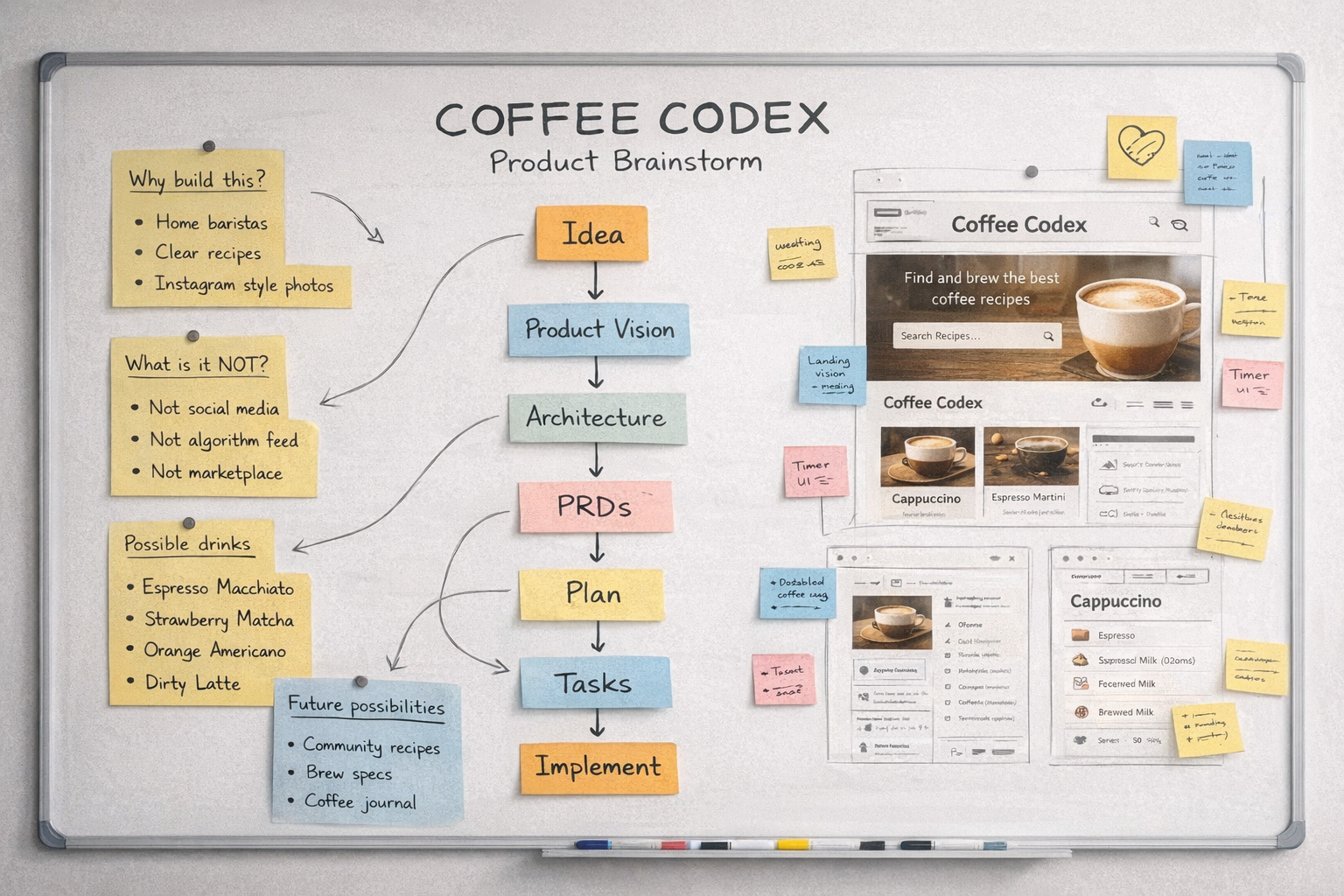
Years ago, I explored a small concept called Coffee Codex — a place to document coffee beans, tasting notes, and brewing experiments.
At the time it was mostly curiosity and conversation. Interesting to talk about.
But never quite built.
A Small Experiment
Recently I came across Hong’s post about AI-driven development and the idea of an AI delivery loop.
It made me curious.
Could AI actually help turn vague ideas into something shippable faster?
So I decided to test the idea. Coffee Codex became the experiment.
Not because it was complex. But because it was unfinished.
The Real Shift in the AI Era
When you start building with AI, something becomes obvious very quickly. Generating code is no longer the hard part.
Features appear quickly.
Sometimes entire components.
Which sounds like progress. But after a while you realize something surprising.
Code is no longer the bottleneck.
Thinking is.
The real constraint is no longer typing speed.
It’s clarity of intent.
The Real Bottleneck
This is something I’ve been actively experimenting with at work as well. Developers today have tools that can generate large amounts of code in seconds. But AI cannot magically understand requirements. It cannot understand domain intent. And it certainly cannot decide trade-offs.
That responsibility still belongs to developers.
The real asset in this new environment is not the person who types the fastest.
It’s the person who understands both the domain and the system well enough to decide what should exist in the first place.
Developers who rely on AI to “figure it out” often generate a lot of code. But without intent, that code rarely moves the system in the right direction.
Turning Coffee Codex Into Intent
The starting point for Coffee Codex was very simple.
As a coffee enthusiast, I often wished there was an easy way to look up recipes for modern espresso-based drinks — the kind you see in specialty cafés or creative barista menus.
Things like:
- Espresso Macchiato
- Strawberry Matcha
- Orange Americano
- Dirty Latte
At first, this was just a vague idea. Something interesting to talk about, but not concrete enough to build. And this is exactly where most ideas fail.
They jump too quickly from vague inspiration → implementation.
In the AI era, that temptation becomes even stronger. You can prompt a tool and immediately generate code. But without investing in the thinking phase first, AI simply accelerates confusion.
So instead of starting with code, I deliberately paused and focused on defining the product itself.
Defining the Product
Coffee Codex eventually became:
A curated, artistic digital catalog of modern espresso-based and creative coffee drinks.
This definition immediately clarified the boundaries of the system.
It is NOT
- A social feed
- A trending algorithm platform
- A marketplace
- A generic recipe app
It IS
- Minimal
- Structured
- Design-forward
- Curated
- Invite-only (for the MVP)
The product reflects the aesthetic and philosophy of modern specialty cafés.
Carefully designed menus.
Thoughtfully crafted drinks.
Quality compounds before volume.
From Vision to Structure
Once the product vision became clear, the next step was turning that vision into something tangible.
Instead of jumping directly to implementation, the idea was gradually refined into a set of intent artifacts.
The process looked like this:
Idea
↓
vision.md
↓
architecture.md
↓
feature specs
The goal is simple. Turn a vague concept into explicit intent.
vision.md
Defines:
- what the product is
- what it is not
- the design philosophy
- the target experience
architecture.md
Defines:
- system boundaries
- major components
- how the pieces interact
- technical constraints
Feature Specs
Once vision and architecture are clear, the system naturally decomposes into features.
For Coffee Codex, this resulted in twelve features:
- App shell
- Recipe listing
- Recipe detail
- Image carousel
- Recipe filters
- Recipe search
- Random recipe
- Recipe views
- Authentication
- Admin recipe management
- Image uploads
- Tagging
Each feature exists for a reason. Each feature represents a piece of product intent.
At this stage, there is still almost no implementation.
Only clarity.
Intent Before Execution
This stage is intentionally slow. Because the goal is not to produce code. The goal is to produce understanding. In traditional development, this thinking phase often gets compressed or skipped.
In AI-driven development, skipping it becomes even more dangerous. AI is extremely good at generating output. But it cannot decide what should exist.
That responsibility still belongs to humans.
The Project Is Intentionally Paused
If you explore the repository today, you'll notice something unusual. Most of the work so far lives inside the specs.
Twelve feature specifications. Very little implementation.
That is deliberate.
The project is currently paused at the intent stage. Because the next step is where the real experiment begins.
What Comes Next
In the next post, I’ll walk through how each feature moves through a development flow I’ve been experimenting with:
Plan → Tasks → Implement
With two human checkpoints along the way.
When the intent is clear, something interesting happens. Execution becomes surprisingly simple. And AI becomes an accelerator rather than a decision maker.
Coffee Codex Today
For now, Coffee Codex is simply a small experiment. An old idea revisited.
Built differently this time.
More deliberately.
Repositories
Client
https://github.com/helmikhaled/coffee-codex-client
Service
https://github.com/helmikhaled/coffee-codex-service
App
coffeecodex.myThe Principle
AI is incredibly good at writing code. But it cannot decide what problems are worth solving. It cannot define intent.
That responsibility remains human.
And in the AI era, that responsibility matters more than ever.